Position and events
The device records time and position. Movement and ignition events depend on the model and how it is installed.

A tracker in your vehicle calculates a position from navigation-satellite signals. It reports through a mobile network to the tracking platform, where authorised people can see the latest received position, recorded trips and configured alerts. Here is what each step means in practice.
The map shows what the device last reported. It is not a continuous camera view of the vehicle.
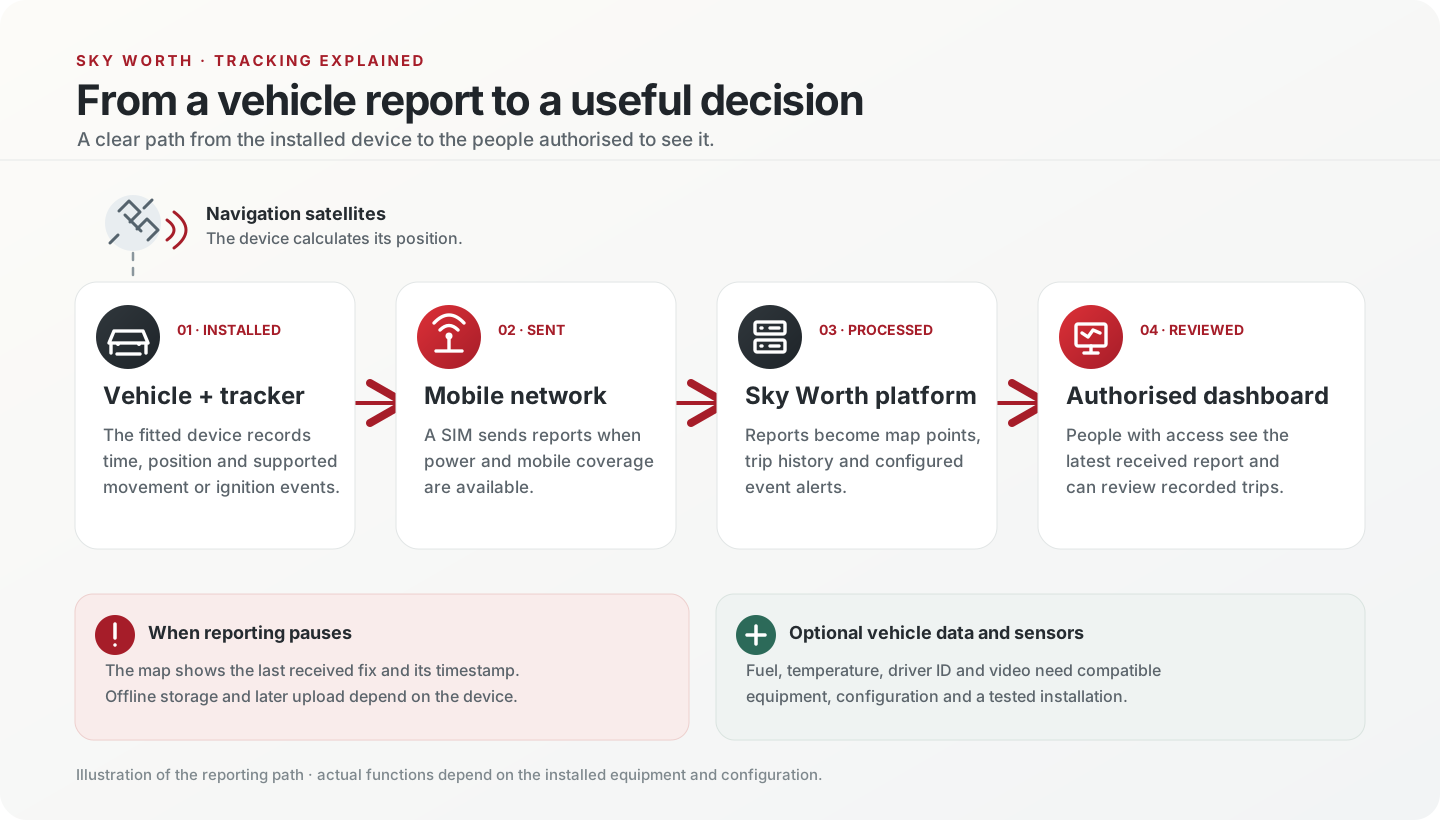
The device records time and position. Movement and ignition events depend on the model and how it is installed.
A working SIM, power supply and mobile connection let the device send its reports. Reporting intervals depend on configuration.
Named users see their assigned vehicles, review recorded trips and receive the alerts configured for their account.
Depending on the device and agreed setup, core tracking can show the latest valid location, when it was reported, movement or ignition status, trip history, stops and configured alerts. Managers can use the history to review a delivery route or confirm an arrival.
Before handover, ask to see a live position, a short completed trip and one alert relevant to your operation. Check the timestamp as well as the map pin.
A vehicle can stop reporting when it has poor mobile coverage or satellite reception, loses power, or has a device or SIM fault. The dashboard should show the time of the last valid report, so an old location is not mistaken for a current one.
Some compatible devices can store reports during a network outage and upload them later. This must be checked for the exact model and configuration; it should not be assumed for every tracker.
Position alone does not measure tank fuel level, engine faults, cargo temperature or who is driving. Those functions may require a compatible vehicle interface, sensor, camera or driver ID reader, followed by installation, calibration and platform testing.
Sky Worth quotes optional equipment separately and checks the actual readings on the vehicle before calling a feature active. See how fuel monitoring is scoped →
It may still calculate a position, but the platform cannot receive a new report until the device has a working connection. Offline storage and later upload depend on the device and its configuration.
No. Fuel readings need a compatible vehicle data source or sensor and calibration. We check compatibility before quoting fuel monitoring.
Access must be limited to the right vehicle, time period and person. A shareable link needs its own privacy and permission controls; do not assume it is included with standard tracking.
No. Tracking may help locate a reporting vehicle, but recovery also depends on power, signal, device concealment and the response process.
Tell us your vehicle types and normal routes. We will propose the setup and demonstrate the agreed functions before handover.